
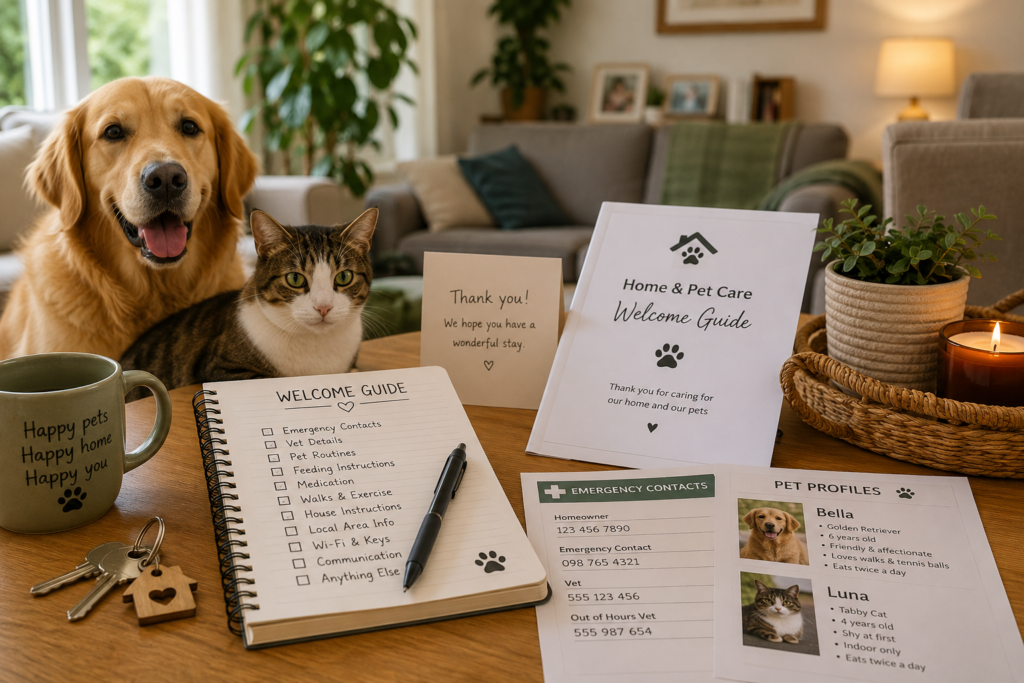
When someone steps into your home to care for your pets, they are entering a world that is completely normal to you, but brand new to them.
You know where the dog lead lives. You know which cupboard holds the cat food. You know the funny noise the boiler makes, the shortcut to the park, the bin day, the vet’s number, the way your dog reacts to the neighbour’s spaniel, and the exact look your cat gives when dinner is five minutes late.
A Guardian does not know those things unless you tell them.
That is why a home and pet care welcome guide is one of the most useful things a Homeowner can prepare before travelling.
A good welcome guide helps your Guardian care for your pets and home with confidence. It reduces stress, prevents confusion, and gives everyone a clear reference point if questions come up while you are away.
It does not need to be complicated or overly formal. In fact, the best guides are often simple, clear, and human. The aim is not to create a legal manual. The aim is to help someone understand your home, your animals, your routines, and your expectations.
At The Guardians Tribe, we believe trusted home and pet care begins with clear communication.
Your welcome guide is one of the strongest trust tools you can create.
Why a Welcome Guide Matters
House and pet sitting is built on trust, but trust needs practical support.
Even the most experienced Guardian cannot guess your pet’s routine or know the quirks of your home without guidance. A welcome guide gives them the information they need to care properly, make sensible decisions, and keep your pets settled while you travel.
It also gives you peace of mind.
Instead of trying to remember everything during a rushed handover, you can prepare the important details in advance. Your Guardian can read it before they arrive, refer back to it during the stay, and message you only when something genuinely needs clarification.
For pets, this matters enormously.
Many animals depend on routine. Feeding times, walk routes, sleeping places, medication, and small daily habits all help them feel secure. When their people are away, familiar structure becomes even more important.
A clear home and pet care welcome guide helps your Guardian maintain that structure.
It also protects the relationship between Homeowner and Guardian. Misunderstandings often happen when expectations are assumed rather than explained. A written guide reduces those gaps.
Start With the Essentials
Begin your welcome guide with the key information your Guardian may need quickly.
This should include your full name, contact number, emergency contact, travel dates, expected return time, and the address of the home. You should also include your vet’s name, phone number, address, and out-of-hours emergency instructions.
If you have a trusted neighbour, friend, or family member nearby, include their details too, but only if they have agreed to be contacted.
It is also helpful to write down what should happen in an emergency. For example, do you want the Guardian to contact you first, contact the vet first, or use their judgement depending on the situation?
The clearer this is, the easier it is for your Guardian to act calmly if something unexpected happens.
This section should be easy to find. You may even want to place emergency numbers at the top of the guide or in a separate quick-reference box.
When someone is dealing with a poorly pet, a locked door issue, or a household problem, they should not have to search through pages of notes to find the right number.
Pet Profiles and Personalities
Every pet has their own personality, and this is where your guide can become really valuable.
Create a section for each animal. Include their name, age, breed or type, personality, normal behaviour, and anything that may be unusual for someone who does not know them.
For example, one dog may bark at the door but settle quickly. Another may be nervous around men, reactive on the lead, or scared of thunder. A cat may hide for the first day, refuse food if watched, or only drink from a certain bowl.
These details may seem small, but they help your Guardian understand what is normal.
That matters because it helps them spot when something is wrong.
If your cat usually hides for a few hours after a new person arrives, your Guardian will not panic. If your dog normally refuses breakfast on rainy days, they will not assume illness immediately. If your rabbit needs careful handling or your chickens have a particular bedtime routine, your Guardian can follow it properly.
Trusted pet care is not only about feeding and walking. It is about understanding the animal in front of you.
The more honest you are in this section, the better the match and the smoother the stay.
Feeding Routines
Food is one of the most important parts of any pet care routine.
Include exactly what each pet eats, how much they eat, when they eat, and where their food is kept. If you use grams, scoops, tins, pouches, or handfuls, explain clearly. If your pet has different food in the morning and evening, write it down.
Do not assume your Guardian will know what “normal amount” means.
If treats are allowed, include which treats, how many, and when. If certain foods are forbidden, make that very clear. Some pets have allergies, sensitivities, weight issues, or medical diets, and mistakes can have serious consequences.
Also include food-related behaviours.
Does your dog guard food? Do your cats need feeding separately? Does one pet try to steal from another bowl? Does your pet need medication hidden in food? Should bowls be washed after every meal?
These details help your Guardian keep mealtimes calm and safe.
For many pets, feeding is not just about nutrition. It is part of their emotional rhythm. Keeping it consistent can make a big difference while you are away.
Walks, Exercise and Outdoor Time
If your pets need walks or outdoor time, be specific.
For dogs, include how many walks they need each day, how long the walks usually are, what routes they know, where they can and cannot go, and whether they are allowed off lead.
If your dog must stay on lead at all times, say so clearly.
Include behaviour around other dogs, children, cyclists, livestock, traffic, cats, and strangers. If your dog pulls, lunges, barks, freezes, chases, or becomes anxious, your Guardian needs to know before the stay begins.
This is not about making your pet sound difficult. It is about keeping everyone safe.
For cats, explain whether they are indoor only, allowed outside, use a cat flap, or need to be kept in at certain times. For smaller animals, birds, reptiles, horses, chickens, or livestock, include clear instructions for outdoor access, cleaning, feeding, and safety checks.
Exercise needs vary hugely.
A young working breed dog may need structured activity and mental stimulation. An older dog may only need gentle walks. A nervous rescue may need calm, quiet routines rather than busy parks.
Your Guardian should not have to guess.
Medication and Health Needs
If your pet takes medication, this section needs to be very clear.
Include the medication name, dosage, timing, where it is kept, how it should be given, and what to do if a dose is missed. If the medication must be given with food, after food, or at a strict time, write that down.
It is also useful to include any known health conditions, allergies, previous injuries, mobility issues, or signs to watch for.
For example, does your dog limp after long walks? Does your cat have a history of urinary issues? Does your pet become stressed easily? Are there symptoms that mean the vet should be contacted quickly?
Your Guardian does not need to be frightened by a huge medical history, but they do need the information required to care safely.
If the care is complex, talk it through on a video call and during handover. Ask the Guardian whether they are comfortable with it before confirming the arrangement.
Some Guardians are experienced with medication and special needs. Others are not. Honesty helps everyone make the right decision.
Home Instructions
A welcome guide is not only about pets. It should also help your Guardian understand the home.
Include Wi-Fi details, heating instructions, hot water, appliances, bins, recycling, alarms, keys, parking, garden care, post, deliveries, and any household quirks.
If something is fragile, difficult, or off limits, say so politely and clearly.
For example, if a door must be locked in a certain way, write it down. If the oven has a trick, explain it. If the bathroom window sticks, mention it. If plants need watering twice a week, include which ones and how much.
These details prevent unnecessary messages and avoid small problems becoming bigger ones.
Also be clear about what spaces your Guardian can use. Which bedroom are they staying in? Which cupboards or storage areas are private? Are visitors allowed? Can they use the washing machine? Is there anything they should avoid?
Clear boundaries make the arrangement feel more respectful for everyone.
Communication During the Stay
Before you travel, agree how communication will work.
Some Homeowners love daily photos and updates. Others prefer a message every few days unless there is a problem. Some want videos, some want simple written check-ins, and some want confirmation after each walk or medication dose.
There is no single right answer.
The key is agreement.
Write your preference into the welcome guide so your Guardian knows what feels reassuring to you. Also include how to reach you if something urgent happens, especially if you will be in another time zone or somewhere with limited signal.
It is wise to separate normal updates from urgent situations.
For example, normal updates might be sent once a day by WhatsApp. Urgent situations might require a phone call, followed by a message if you do not answer.
Good communication helps Homeowners relax and helps Guardians feel supported.
Local Area Information
A small local section can be incredibly helpful, especially if your Guardian is new to the area.
Include the nearest shop, pharmacy, vet, petrol station, public transport, good dog walks, safe walking routes, and places to avoid if needed.
If your dog has a favourite field or a route that avoids traffic, include it. If there are livestock nearby, busy roads, aggressive dogs in the area, or local rules around leads, mention them.
You can also include nice extras, such as your favourite café, a good local market, or a quiet place to walk.
This helps your Guardian settle in and care for your pets more confidently.
A Guardian who understands the area will usually feel calmer, and that calmness often passes to the animals too.
Key Handover and Arrival Details
Do not leave key arrangements vague.
Include exactly how your Guardian will access the home, where the keys are, who will meet them, and what time they should arrive.
If you use a key safe, give clear instructions and make sure the code works before you leave. If a neighbour is handing over keys, make sure they know the plan. If you want the Guardian to arrive before you leave so you can do a handover in person, agree the time clearly.
Also explain what should happen when you return.
Should the Guardian wait until you arrive? Can they leave the keys somewhere safe? Do you want a final update before they go?
Simple details like this can prevent a lot of stress.
Final Checks Before You Travel
Before leaving, make sure your Guardian has read the welcome guide and has had the chance to ask questions.
Do not be afraid to repeat important details. It is better to be clear than to hope someone remembers something mentioned quickly during a call.
Check that pet food, medication, cleaning supplies, leads, litter, bedding, and emergency items are easy to find.
Leave the home in a way that helps your Guardian step in calmly.
This does not mean everything has to be perfect. It simply means the essentials are ready, visible, and clear.
A well-prepared home supports better care.
A Welcome Guide Builds Trust
A home and pet care welcome guide is not just a practical document.
It is an act of trust.
It shows your Guardian that you care about helping them do a good job. It shows that your pets’ needs matter. It shows that the arrangement has been thought through properly.
For the Guardian, it creates confidence. For the Homeowner, it creates peace of mind. For the pets, it helps maintain the routines that keep them settled.
This is exactly the kind of care The Guardians Tribe was built around.
We believe home and pet care should feel human, responsible, and clear. When Homeowners and Guardians communicate properly, house and pet sitting becomes safer, calmer, and more meaningful for everyone involved.
Create Better Home and Pet Care Connections
The Guardians Tribe is a global house and pet sitting community connecting Homeowners with verified Guardians for trusted home and pet care.
Homeowners can create detailed listings for their homes and pets. Guardians can create listings showing where they are available, what experience they have, and what type of care they offer. Members can connect directly, arrange video calls, and agree the details clearly before confirming a stay.
A welcome guide is one of the best ways to support that connection.
Because when your pets are family, their care deserves more than guesswork.
Ready to Prepare for Trusted Home and Pet Care?
Create your account with The Guardians Tribe to browse the community and explore live Homeowner and Guardian listings.